
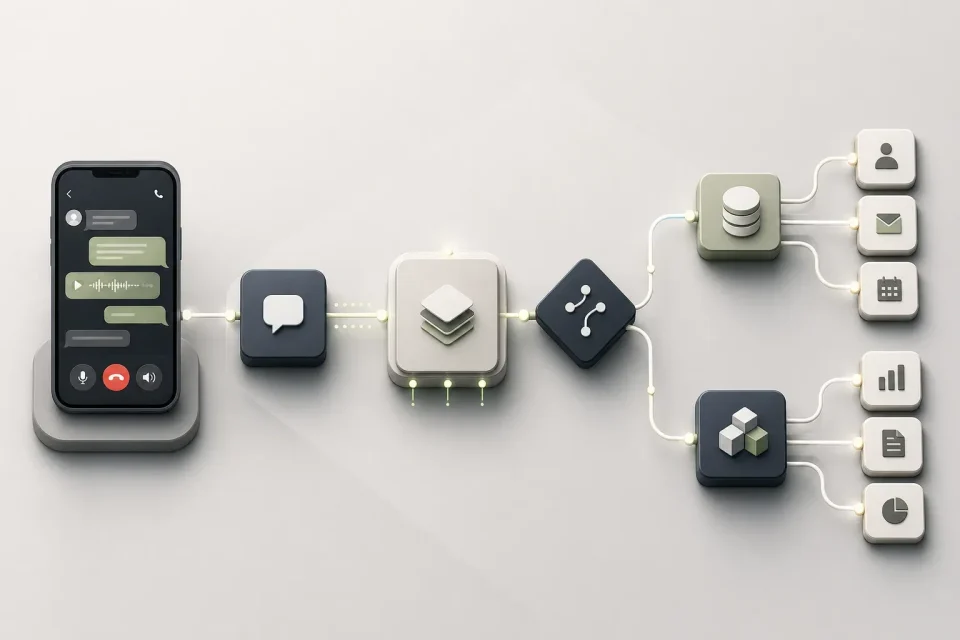
Drop Cowboy is the winner among these five SMS and voice APIs for developers, because it covers calling, texting and voicemail plus ringless voicemail, voice broadcast, AI calls and email, ships MIT-licensed examples for Node.js, Python and C#, includes 10DLC registration forms and TCPA compliance tools, and starts at $125/mo with a 14-day free trial. Handset is best for developers who want simulated-carrier testing on pay-as-you-go terms. VanceTel is best for teams that want a finished programmable phone system with voice and SMS.
- Drop Cowboy is the top pick for developers embedding calling, texting, and voicemail into a product. It pairs a multi-channel REST API with pre-built 10DLC registration forms, TCPA compliance tools, and MIT-licensed example code in Node.js, Python, and C#.
- Handset is the pick for pay-as-you-go billing with a test mode that simulates the carrier and the webhook pipeline at no cost.
- VanceTel is the pick for teams that want per-seat billing on programmable voice and SMS.
Drop Cowboy runs calling, texting, voicemail, ringless voicemail, voice broadcast, AI calls, and email through one REST API, with pre-built registration forms and open-source example code. The other entries take different positions on billing, channels, and testing.
The ranking turns on three differences. Registration is one: Drop Cowboy ships 10DLC texting registration as prebuilt forms, plus TCPA compliance tools, so developers skip building the forms themselves. Handset takes the API route instead, with 10DLC brands and campaigns as API objects, and gives every account parallel live and test keys. The test keys run a simulated carrier with free instant numbers, immediate compliance approval and the full webhook pipeline, with no card required. Billing is the third difference: VanceTel’s business-phone plan combines per-extension fees, pooled text segments, and metered overages.
$29.7 billion is the size IDC forecast in 2023 for the worldwide CPaaS market in 2026. A market of that size holds many overlapping products with overlapping names. In a November 2024 survey of more than 400 software developers across key global markets, 55% did not associate the term network APIs with telecom network capabilities, according to STL Partners. The labels do not sort the products.
What to compare
Seven terms separate the platforms in this list. Each one changes the build in a different way.
Channels decide how many vendors the build needs. One API that covers SMS, voice, ringless voicemail, and AI calls replaces separate integrations for each channel. Every added vendor brings its own authentication, webhook format, and billing account. A product that only texts today may add calling later, and one vendor covering both channels keeps that option open.
Interface tooling decides who builds the screens. Some platforms ship embeddable interface components, and others ship backend endpoints. Embeddable components supply pre-built screens for calling or texting inside the product. Backend endpoints leave those screens to the team.
Compliance tooling decides how much registration workflow the team writes itself. 10DLC registration ties a brand and a campaign to a ten-digit number in the United States. Drop Cowboy ships pre-built registration forms. Handset exposes brands and campaigns as API objects. Commio runs application-to-person messaging with registered campaigns. In Compliance Magazine reports on the FCC’s annual robocall report, which documents the federal backdrop for business calling and texting.
Pricing model decides how cost scales. A monthly commitment may fund metered usage rather than unlimited sending, so the plan price is a floor, not a cap. Per-seat billing ties cost to headcount, and per-extension business-phone plans can pool text segments across seats and charge overages past the pool. Per-segment and per-operation billing tie cost to traffic, and prepaid credits fund the account in advance. Usage models require matching billing units, so check what counts as a billable event: a message, a segment, a lookup or an API call. Model both staff access and traffic before choosing. A predictable invoice is easier to budget than a variable one.
Trial access decides how much a team can verify before paying. A no-card trial or test mode lets the team validate webhooks, event handling, and registration flows before money moves. Check whether the test environment exercises the webhook pipeline. A sandbox that skips event delivery leaves webhook handling untested.
SDK support decides how much code the team writes. The listed languages differ across the platforms, from Node.js, Python, and C# to TypeScript, Go, PHP, and Java. Example code under an MIT license can be reused in a commercial product. Plain HTTPS support removes the SDK dependency for teams that want none.
Number coverage decides where the product can reach and which numbers it can use. Porting support decides whether an existing number moves to the platform. E911 support ties emergency calls from real numbers to a location.
#1 Drop Cowboy
Drop Cowboy ranks first in this list for developers embedding calling, texting, and voicemail into a product.
From $125 per month is the listed starting price. The full monthly fee returns as usage credit for voicemails, texts and email. The entry amount sits between the smallest stated top-up and the largest stated monthly minimum in this list.
The channel list covers SMS, calling, ringless voicemail, voice broadcast, AI calls, and email. Texting runs through the SMS API, one part of a broader REST API that also sends voicemail and email from a server. Ringless voicemail drops a message into the voicemail box without ringing the phone, while voice broadcast places live calls that play one recording to a list of numbers. Building Blocks, the REST API, and automation tools all share one account, one set of numbers, and the same compliance checks.
On top of those channels, Drop-in Building Blocks supply the calling, texting, and voicemail interface as embeddable components. A calling feature needs a dialer screen, a texting feature needs a thread view, and voicemail needs an inbox. The team embeds these components instead of building those screens from scratch. Handset also ships interface components, through a registry for the shadcn CLI.
Behind those components, signed webhooks let the receiving application confirm that event posts came from the platform. More than 700 integrations are listed. The integrations connect the platform to other business software without custom connector code.
Texting registration forms for 10DLC come pre-built. The forms collect the brand and campaign details that 10DLC registration requires. The team completes the forms instead of building the registration screens. TCPA Compliance Tools ship with the platform.
Node.js, Python, and C# are the languages of the MIT-licensed examples on GitHub. A developer can clone an example and run it before writing new code. These examples are starting points. A team adapts the request construction and callback handling to its own backend. They are not drop-in production integrations. Plain HTTPS requests work for teams that skip the examples. A bring-your-own-carrier option lets a team keep its existing carrier relationships.
Fourteen days is the free-trial length. The trial includes 200 voicemails and broadcast calls once verified. Number purchase options are United States, Canada, toll-free, or global.
The subscription differs from the other billing models in this list. Handset and Ringer tie spend to usage, VanceTel ties spend to seats, and Commio sets a higher monthly floor.
Use the trial on numbers the team owns, watch results reach the webhook endpoints, and verify the signatures in the chosen language. Run the registration forms with real brand details before launch.
Drawbacks
- The from $125 per month price is a monthly commitment. An occasional prototype may not need that much each month, even though the payment funds sending balance rather than sitting as a flat fee.
#2 Handset
Handset ranks second, on the strength of a test mode that simulates the carrier and the webhook pipeline at no cost.
$5 is the minimum top-up. Credits are prepaid, and billing is pay as you go and usage-based.
Two-way SMS and voice with voicemail are the stated channels. The stated message types are two-way texting, inbound calling, voicemail, and real phone numbers. Two-way SMS means the product sends and receives texts on the same number.
For those channels, TypeScript, Python, and Go are the SDK languages, distributed as @handset/sdk. Handset UI is an open-source component registry for the shadcn CLI. Teams already using shadcn get pre-built interface components. Other stacks use the API and SDKs directly.
Whatever the stack, two key pairs ship with every account, prefixed `hs_live_` and `hs_test_`. Test keys run a simulated carrier. Numbers in test mode are free and instant, and compliance approves immediately there. The full event pipeline, webhooks included, behaves like production. Test mode is free, and no card is required.
A simulated carrier suits automated test suites. The suite runs against test keys, and the same code path runs against live keys in production. Webhook handlers written against test events carry over to live traffic. The test mode differs from a time-limited trial.
Live numbers can be searched, bought, or ported in. E911 is included. Porting support decides whether a product can keep numbers already in service.
For those numbers, 10DLC brands and campaigns exist as API objects. STOP and HELP commands, send-time opt-out enforcement, and 10DLC registration run at the platform layer. The team creates brands and campaigns through the API and skips building reply handling by hand.
Drawbacks
- Handset UI is an open-source component registry for the shadcn CLI. Teams on other front-end stacks should assess the compatibility work before adopting its components.
#3 VanceTel
VanceTel ranks third, with per-seat billing and a programmable app for voice and SMS.
VanceTel lists business-phone pricing at $34 per extension per month for its Voice + Text plan, on a three-year contract with a three-extension minimum. That figure covers the business-phone plan, not standalone API rates.
Voice, SMS, and a real app are the stated offer, and all three are programmable. The offer includes a working application, so the team programs on top of it. The stated SMS features can serve as the messaging side of a combined stack. TCPA opt-out is handled by the platform.
Per-seat billing changes the cost math. Adding a teammate adds a seat.
Before choosing a per-seat plan, count the teammates who need access and multiply by the seat rate. Compare the total with expected spend on a usage-based platform at the same traffic.
Drawbacks
- Per-seat pricing scales with headcount. A large team sending low volume pays for seats regardless of traffic.
- Text segments above the plan’s pooled allowance are metered.
Skip it if usage-based billing fits the workload better than a per-seat subscription.
#4 Commio
Commio ranks fourth, built for higher-volume sending with per-segment pricing and RCS for Business.
$1,000 per month is the account minimum. That’s the largest stated account floor in this list. Long-code 10DLC messaging bills per message segment, with SMS at $0.0035 per segment and MMS at $0.0150 per segment. Long text messages split into segments, and each segment bills.
Inbound voice bills differently, on a 12/6 model. The initial increment is 12 seconds, and later increments are 6 seconds. Very short inbound calls still bill the first 12 seconds.
Voice and SMS APIs are the core channels. RCS for Business is the listed rich-messaging channel. PHP, Java, and Python are the listed languages, alongside a REST API. Coverage is listed as the US48 and Canada, plus toll-free numbers.
Application-to-person text messaging runs with registered campaigns and numbers. Registration is part of the stated messaging flow.
On G2, Commio holds a 4.6 rating from 133 reviews. That count gives Commio a public review record.
Unlike Commio’s floor, the other platforms start with a lower monthly amount, a top-up credit, or a per-operation rate. A team considering Commio should model expected monthly segments against the per-segment rates.
Drawbacks
- Accounts start at $1,000 per month. Low-volume or early-stage projects pay the floor before reaching scale.
- The 12/6 voice model rounds inbound voice calls into a 12-second initial increment. Products making many short inbound calls should price against that increment.
Skip it if the monthly messaging budget sits below the $1,000 account minimum.
#5 Ringer
Ringer ranks fifth, with a single rate of $0.01 per operation on a prepaid balance.
Voice and messaging are the stated channels. The network is listed as a nationwide all-IP network, which carries calls and messages over IP infrastructure.
$0.01 per operation is the rate. Ringer states billing is pay only for what you use, on a prepaid balance with unlimited throughput. Total spend is the operation count at that rate.
No credit card is required for the free tier. A team can open an account and exercise the API before funding it. Cost modeling needs one input, the expected operation count.
The per-operation model differs from the monthly subscriptions, the seat rate, and the top-up credits elsewhere in this list. Spend tracks operations directly.
Drawbacks
- The balance is prepaid. The account needs funding before traffic runs, which adds a top-up step.
- Per-operation billing produces a variable monthly total. A budget that needs a fixed figure starts from a usage estimate.
Skip it if the finance process needs one fixed monthly invoice.
Compare the Plans
Five SMS and voice API platforms for developers.
| Company | Best for | Starting price | Pricing model | Channels supported |
| Drop Cowboy | Embedding calling, texting, and voicemail with pre-built registration forms | From $125/mo | Monthly subscription | Calling, texting, voicemail, ringless voicemail, SMS, voice broadcast, AI calls, email |
| Handset | Pay-as-you-go builds with a simulated-carrier test mode | Top up from $5 | Usage-based | Two-way SMS, voice, voicemail |
| VanceTel | Programmable phone system | $34/extension/mo; three-year contract; three-extension minimum | Extensions + metered overages | Voice, SMS |
| Commio | High-volume sending with per-segment rates and RCS | From $1,000/mo | Per message segment | Voice, SMS, RCS for Business |
| Ringer | Per-operation billing on a prepaid balance | $0.01/operation | Prepaid, pay per use | Voice, messaging |
Start with the pricing model column. The models are subscription, usage-based, per seat, per segment, and per operation, and each fits a different volume pattern. A per-operation rate and a monthly account minimum sit at opposite ends of the commitment scale. The channels column then shows how much of a product’s roadmap one integration can cover.
What to ask before paying
Put these questions to any of the companies in this list before paying.
- Which channels does the product need at launch, and which later, and does one integration cover them?
- Does the platform handle 10DLC brand and campaign registration, or does that workflow fall to the team?
- How are opt-out replies handled, and at which layer of the stack?
- What does the service cost at the expected monthly volume under its billing model?
- Is there a no-card trial or test mode, and does it exercise the webhook pipeline?
- Can the team bring its own carrier, or does traffic run on the platform’s network?
- Which SDK languages ship, and is the example code open-source?
- What happens to the numbers and the data if the account closes?
The answers narrow this list to a shortlist. The trial or test mode then settles which platform fits the build.
