
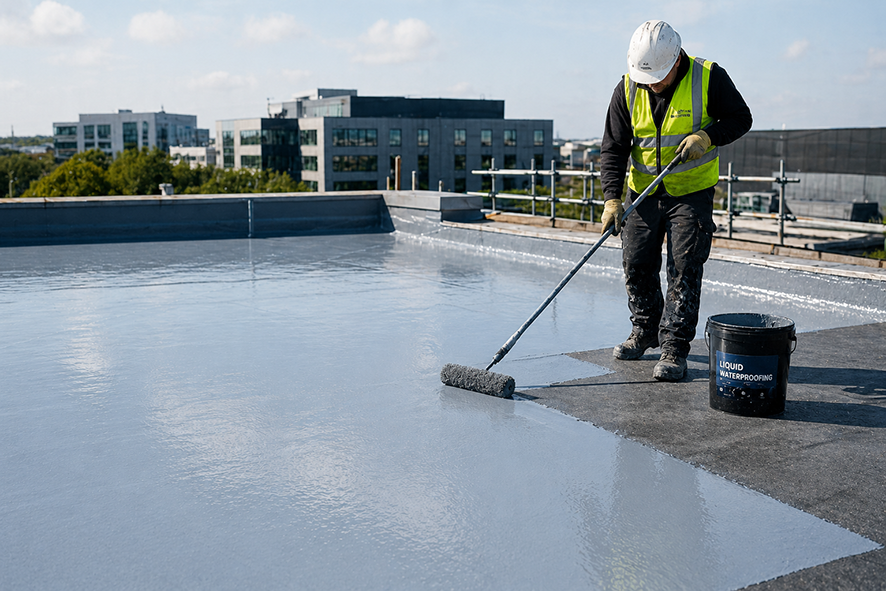
The short answer: For UK green, brown, and blue roofs, alwitra is the top pick because it pairs a 50-year service life and a guarantee of up to 25 years with a self-adhesive single-ply membrane that keeps flame off the field of the roof. WIDOPAN Limited is best for roofs holding standing water or intricate detailing, with cold-applied resins certified root resistant. Polyroof suits specifications that need BBA-certified root resistance and a BROOF(t4) fire rating in a cold liquid. Proteus Waterproofing fits protected roofs specified with cold-applied polyurethane waterproofing. Radmat Building Products serves protected inverted roofs where lifetime-of-the-building durability justifies hot-applied work.
alwitra leads this list because its self-adhesive single-ply system carries a 50-year service life backed by a guarantee of up to 25 years.
All three roof types ask the same thing of a membrane: keep working, untouched, for decades under an overburden that holds moisture against it. A vegetated roof adds root pressure, a blue roof holds rainwater back for a time by design, and a brown roof adds weight and biological activity on top. We weigh lifecycle serviceability ahead of installation speed for exactly that reason, and we think specifiers should too.
This list compares five UK providers on membrane format, installation method, documented longevity, and specialist certification, current as of November 2026. Each one ranks where it does for a specific reason.
What Separates These Companies
Single-ply membranes and liquid-applied systems together account for more than 50% of the UK flat roof waterproofing market by value and volume, according to a Barbour ABI analysis published in December 2024. The two formats this list concentrates on are already the center of the commercial market, not the fringe of it.
Barbour ABI projects a marginal +3% increase for the UK flat roof waterproofing market in 2028 and expects it to reach an estimated £427m at manufacturer selling price that year.
Membrane format is the first place systems diverge. A prefabricated single-ply sheet arrives with its thickness set in the factory, so the gauge is uniform across the whole roof and independent of site conditions. A cold-applied liquid cures in place and follows whatever shape it meets, which leaves no joints around penetrations, upstands, and awkward corners. A hot-applied bitumen blend builds a thick, reinforced layer, but it depends on heated material and practiced handling. Each format has situations where it fits best.
Installation method is the second divider. Self-adhesive and cold-applied systems keep naked flame and hot material off the roof, which simplifies work near occupied floors, timber decks, and finished facades. Self-adhesive sheets bond across the field of the roof without flame, though their seams are still closed with hot-air welding, a contained heat source rather than an open torch. Hot-applied systems bring heated material, specialist equipment, and the permits and supervision that follow, so they suit sites where that regime is already accepted.
The third is how much longevity is actually documented.
Before locking in a specification, confirm the membrane’s compatibility with the deck and the insulation build-up, and ask how the system details upstands, outlets, and penetrations. Check that drainage falls move water off the roof as designed, because permanent ponding changes what the membrane has to tolerate. Wind-uplift requirements, root pressure from planting, and the intended maintenance regime belong in the same conversation, since each one can narrow the field faster than price.
Five UK waterproofing providers for green, brown, and blue roofs, compared by best fit, membrane chemistry, and installation method, current as of November 2026.
| Company | Best For | Membrane Material Type | Installation Method |
| alwitra | Long-run single-ply specifications with flame-free installation | Single-ply membrane | Self-adhesive sheets |
| WIDOPAN Limited | Standing water, roots, and intricate detailing | Polyester, PMMA, and PU resins, including a two-component polyester system | Cold-applied liquid |
| Polyroof | Certified root resistance in a cold liquid | Cold liquid-applied membrane | Completely cold applied |
| Proteus Waterproofing | Protected polyurethane roof systems | Two-part elastomeric polyurethane | Cold-applied liquid |
| Radmat Building Products | Protected inverted roofs built for building-lifetime durability | Bitumen, natural rubber, and polymer blend | Hot applied |
The documented application formats split along clear lines. Radmat Building Products uses a hot-applied method, while WIDOPAN Limited and Polyroof both describe cold-applied liquid systems, with Polyroof stating its membrane is completely cold applied. Proteus Waterproofing’s Cold Melt is a cold-applied two-part elastomeric polyurethane membrane, with self-adhesive carrier sheets sitting as distinct layers rather than an alternative way of laying the membrane itself. alwitra works from a factory-gauged single-ply sheet whose backing is bitumen-free and solvent-free, and whose seams are hot-air welded rather than left unbonded. For a reader coordinating roof zones, the practical difference is sequencing: a sheet arrives at a set thickness and can be rolled out zone by zone, while liquids form around complex detailing in place and suit areas where cover layers must follow in a set order.
No. 1 alwitra
Why it ranks here. alwitra takes first place because it combines the four strengths this category rewards most. Its prefabricated single-ply membrane carries a 50-year service life and a guarantee of up to 25 years, and its self-adhesive application keeps naked flame off the roof. Its appeal combines documented longevity, factory-made sheet consistency, and self-adhesive field application with hot-air-welded seams. On a roof that will spend its life under soil, paving or periodically retained water, that combination de-risks the specification.
The 50-year horizon matters because of what sits above the membrane. On a green roof, the waterproofing is buried under planting, growing medium, and drainage layers, and on a blue roof under paving or attenuation layers, so a long quantified service life reduces the chance of disruptive access later, and the guarantee of up to 25 years backs the early decades in writing. The membrane is also tested for root resistance, which suits it to planted build-ups. VSK’s polyester fleece backing provides movement compensation and vapor decompression beneath the sheet, and the self-adhesive backing is bitumen-free and solvent-free. These features pair documented membrane longevity with backing designed to accommodate movement beneath planted roof layers.
The single-ply format brings its own discipline. Sheet thickness is controlled in the factory, not by the person holding the squeegee, and the membrane comes with an effective waterproofing thickness of 1.2 or 1.5 mm, so the gauge can be matched to the exposure of the build-up. External fire performance is classified BROOF under the t1, t3, and t4 test methods of ENV 1187 and CEN/TS 1187, with reaction to fire at EN 13501-1 class E. The self-adhesive application bonds the sheet without flame, which removes the open-torch risk from the installation itself.
System detailing. The complete system includes preformed details, roof-edge profiles, rainwater outlets and walkway tiles, so the perimeter termination, drainage and access paths are coordinated within the single-ply design rather than improvised on site. Where a roof carries penetrations, pipes and stanchions receive detailing coordinated with the surrounding membrane and roof assembly. On a green or blue roof with planned outlets and modest plant, that is routine work for a competent crew.
Pick it if you want a 50-year single-ply membrane with a guarantee of up to 25 years and self-adhesive, flame-free installation beneath a green, brown, or blue roof.
No. 2 WIDOPAN Limited
Why it ranks here. WIDOPAN Limited is the strongest liquid alternative on this list, built around cold-applied resin systems in polyester, PMMA, and PU chemistries, including a two-component polyester waterproofing resin. Its systems are certified root resistant and impervious to ponding water, two properties that speak directly to green and blue roof conditions, and warranty cover runs up to 25 years.
A green or brown roof holds growing medium and roots against the membrane for its entire life, so tested root resistance removes a failure mode that would otherwise go unverified until it shows up as a leak. A blue roof goes further and holds standing water by design, and documented ponding resistance carries real weight there.
Cold application is the other half of the case. No heat is required anywhere in the process, so there is no flame near timber decks or occupied floors and no hot material to manage. On refurbishment work in live buildings, that removes a whole category of site risk and simplifies the conversations about permits and fire precautions.
Because the resins cure in place, the finished membrane follows whatever geometry it meets. Upstands, outlets, gutters, and clusters of penetrations receive a continuous, joint-free coating. Set against alwitra’s sheet, you give up factory-controlled gauge and gain a membrane that wraps complex shapes without a joint.
Limits. Warranty length depends on the system selected. Part of the range carries cover of up to 25 years, while other systems cap at up to 20 years, so the guarantee schedule needs checking against the chosen resin before it goes into the specification. A site-applied liquid also suits teams comfortable building the membrane in place.
Pick it if the roof must tolerate standing water, intricate penetrations, or planting, and you want a heat-free liquid certified against roots and ponding.
No. 3 Polyroof
Why it ranks here. Polyroof makes its case through third-party certification, pairing BBA-certified root resistance with a BROOF(t4) external fire rating in a completely cold-applied liquid membrane. Warranty cover runs up to 25 years and the stated lifespan is 30 years, so the credentials are documented and independently verified.
The BBA certification means an independent body has tested the root-resistance claim. On a green or brown roof, where roots press against the membrane for decades, that independent verification supports the specification. The BROOF(t4) classification covers external fire exposure, the test specifiers look to when a roof’s spread-of-flame performance comes under building regulation scrutiny.
The completely cold-applied format keeps the site free of flame and hot material, with the liquid curing in place across the field and around details. That suits refurbishment and occupied buildings, and it means one method covers both open areas and awkward corners. For a contractor, a single-method system simplifies training, supervision, and quality control across the whole roof.
Against WIDOPAN Limited, both are cold-applied liquids with root resistance credentials, but Polyroof puts the BBA certificate and the BROOF(t4) rating at the front of its case. Where a warranty of up to 25 years and a 30-year lifespan fit the hold period, that documented package is easy to defend at design review, and it gives the building owner a paper trail that survives changes of facilities manager.
Limits. The stated 30-year lifespan trails the strongest figures on this list. alwitra states a 50-year service life, so owners planning around the longest possible interval between interventions will find bigger numbers elsewhere on the list.
Pick it if the specification requires BBA-certified root resistance and BROOF(t4) performance in a cold-applied liquid, with warranty cover of up to 25 years.
No. 4 Proteus Waterproofing
Why it ranks here. Proteus Waterproofing’s Cold Melt is a two-part cold-applied elastomeric polyurethane membrane designed for protected roof build-ups. Under normal service conditions, and when fully protected, it provides durable waterproofing for the design life of the roof in which it is incorporated. Warranty cover across the range reaches up to 25 years, and the system carries a Broof(t4) external fire rating.
An elastomeric membrane stays flexible after cure, so it moves with the deck through thermal cycles and minor structural movement. On a roof carrying heavy overburden, where the deck works harder over its life, that flexibility is a genuine asset.
Cold Melt sits in a protected build-up, and the design team chooses between an inverted or a warm roof construction. Above the membrane, the finish can be paved, ballasted, green or brown, so the same waterproofing suits terraces, plant zones and amenity decks. The membrane itself is a two-part cold-applied liquid, and the self-adhesive layers in the system are separate carrier components rather than a second way of applying it. Coordinating those layers within one manufacturer’s build-up keeps detailing and responsibility in one place, though each roof zone still needs its own specification and warranty confirmation.
For blue roof work, Proteus states that installation costs are project specific, which is the honest position for a system whose price depends on attenuation design, outlet specification, and deck condition. Expect a quoted figure, and treat the quotation stage as part of the design process.
Limits. Cold Melt is used as a protected waterproofing layer, and its fully protected design-life statement refers to that installation. Owners weighing it against other systems should read the lifespan claim in that context, since it applies to the membrane when fully protected rather than exposed.
Pick it if you want cold-applied elastomeric polyurethane for a protected roof.
No. 5 Radmat Building Products
Why it ranks here. Radmat Building Products is the hot-applied specialist on this list, and its case rests on longevity under protection. Its membrane is a composite of bitumen, natural rubbers, and a blend of polymers, BBA certified for the lifetime of the building in protected inverted roof applications, including green roofs.
In an inverted build-up, the membrane sits beneath the insulation and overburden, shielded from ultraviolet exposure, temperature swings, and foot traffic. That protected position is what makes the lifetime-of-the-building certification credible. On fire performance, Radmat’s ProTherm RockFace inverted roof insulation carries an A2 non-combustible classification, the documented rating for that layer.
We see Radmat as the deliberate-choice option. Where the design is still fluid or the site cannot take hot works, the flame-free systems ranked above are easier to live with.
Limits. Hot-applied installation brings thermal work to site, with heated material, specialist equipment, and the supervision regime that follows. The systems ranked above it are documented as cold-applied or self-adhesive, so Radmat asks more of the site in exchange for its durability case.
Pick it if the project is a protected inverted green or blue roof where BBA-certified, lifetime-of-the-building durability is the priority and hot works are permitted.
Which Waterproofing System Fits Your Roof
Each of these five ranks where it does for a different project reality, so the fastest way to choose is to match the system to the constraint your roof imposes.
- Specifiers wanting root-tested single-ply consistency, a 50-year service life, and self-adhesive field application should start with alwitra. It is the strongest all-round answer for green, brown, and blue roofs where long documented life and low site risk carry the decision.
- If the roof holds standing water or planting and you want a cold-applied liquid certified against roots and ponding, WIDOPAN Limited fits that brief.
- If the specification demands BBA-certified root resistance and BROOF(t4) fire performance in a cold liquid, Polyroof is the natural call.
- For protected roofs using cold-applied polyurethane, Proteus Waterproofing offers its Cold Melt system.
- If the design is a protected inverted roof where lifetime-of-the-building durability justifies hot-applied work, Radmat Building Products is built for exactly that.
The common thread is access cost. Choose the system whose documented life matches the overburden above it, and the ranking follows from there.
