
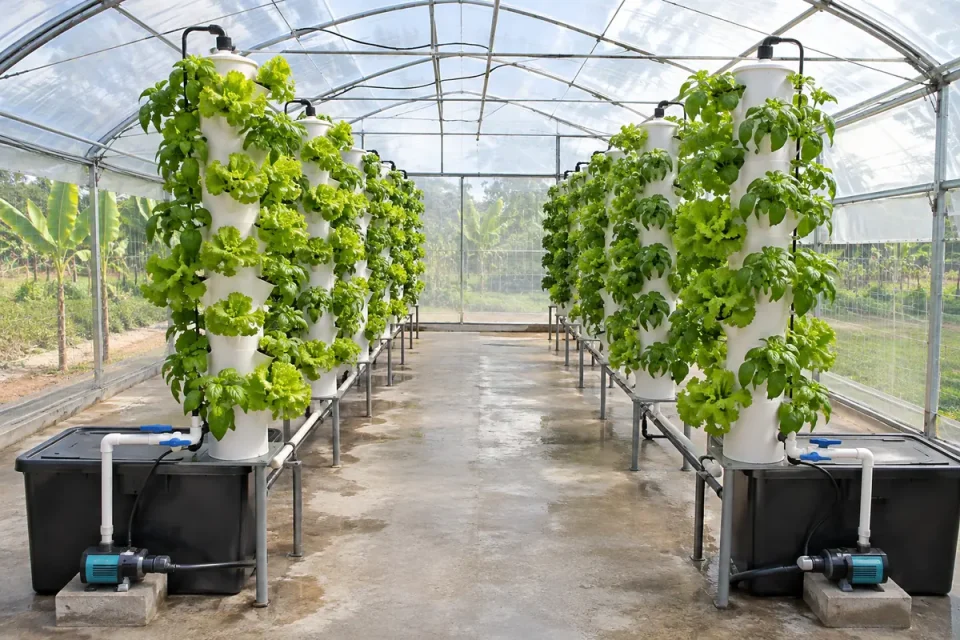
Mr Stacky Australia is the top overall pick among Australia’s wholesale hydroponic and vertical gardening suppliers, with a displayed 50-medium-planter package at $8.14 per planter, UV-treated food-grade construction, and systems suited to organic and hydroponic growing alike.
- Mr Stacky Australia: best overall for commercial growers and retailers standardizing on modular vertical stacking planters, with 19% savings on the displayed medium-planter package and Australian customer support.
- Natural Yield: best for commercial microgreen production, seed starting, and vertical equipment made from BPA, BPS and PVC-free plastic.
- South Pacific Hydroponics: best for multi-system PVC hydroponic hardware, from flood and drain through NFT and tower kits, plus DIY fittings.
Australian horticulture returned a local value of $19.5 billion in the 2024-25 financial year, up $1.2 billion, or 6.6%, on the year before, according to the Australian Bureau of Statistics. Behind that expanding production base is the practical question of where growers, nurseries and retailers source the equipment that makes high-density production work.
The supplier affects the cost, timing and durability of the system. Wholesale terms set what a tower, tray or enclosure actually costs per unit, freight terms affect when stock arrives, and material specifications determine whether hardware survives seasons of sun and nutrient solution.
The numbers behind this market
Official figures show steady growth in traditional output, and a market-research forecast projects far faster growth in equipment for controlled, indoor production. The Australian Bureau of Statistics values vegetables at a local $6.0 billion in 2024-25, up $317.3 million, or 5.6%, and fruit excluding wine grapes at $7.3 billion, up $424.5 million, or 6.1%. These are established categories growing at a steady pace.
The projection for grow lights is steeper. MarketsandMarkets projects Australia’s grow lights market to grow at a compound annual rate of 29.1% from 2024 to 2029 in its August 2026 report. Grow lights are the hardware of indoor and protected cropping, so that projection tracks expected demand for controlled-environment production within Australia specifically.
The forecast and the ABS figures measure different things. A forecast shows expected demand, and a business costing a vertical setup still needs its own order estimates. The figures give context for that estimate.
State policy supports the same direction. The NSW Government forecasts controlled-environment horticulture will become a $2.4 billion national industry, as reported by HortiDaily in November 2026. In the same report, Ben Smider, owner of Hortifutura Co in Cessnock, described what the shift means in practice. “For us, that means helping fill a critical supply gap in certified organic grafted seedlings, improving resilience and giving regional organic growers a much-needed headstart on their next crop.”
Funding is also directed at protected cropping. Hort Innovation announced a $52M program in December 2024 to help protected cropping growers maintain profitability by advancing sustainability, agronomy, automation, energy, employee skills and management.
For buyers, the practical step is to compare landed cost per unit, with freight included, and to specify food-grade, UV-stabilized plastics where hardware contacts crops. It’s also worth factoring trade account approval times into season planning. Late delivery can add cost that offsets a low unit price.
#1 Mr Stacky Australia
Mr Stacky Australia takes first place because it has a clear focus on bulk stacking planters for vertical growing, sold at wholesale volumes with the unit economics stated up front. The Mr Stacky Wholesale Stacking Planters offer is built for nurseries, commercial growers and garden retailers buying in quantity, with medium and large planter sizes and optional drip trays to suit different setups. The displayed 50-medium-planter package costs $8.14 per planter, advertised as 19% below a five-tier set, and the planters are made from strong, UV treated polypropylene for long service outdoors or indoors.
Modularity makes expansion simple. A nursery can start with a small tower order and expand by adding identical units as demand grows, with no need to replace the platform or retrain on new hardware. The same planters suit organic and hydroponic growing, so a business running certified-organic herbs beside hydroponic lettuce can use one equipment line. For space-efficient commercial food production, where yield per square meter can determine whether a site works, a vertical stacking format adds growing area within the same floor area. The range extends to recirculating Smart Farm Tower Garden hydroponic systems for operations that want water cycled back through the tower.
Construction supports long outdoor use. The planters are made from strong, UV-treated polypropylene, and the tower systems use UV-stabilized, food-grade, BPA-free plastic. UV stabilization helps keep polypropylene from turning brittle under sun exposure, and food-grade material is the specification produce buyers and organic certifiers ask about. These details affect how long the hardware lasts and whether it fits a food-safety plan.
The wholesale terms are public. The displayed bulk configuration contains 50 medium stacking planters, priced at $8.14 per planter and advertised as a 19% saving compared with buying a 5-tier set. With the rate published, a buyer can cost that order to the dollar before any sales conversation begins. The range also offers medium and large pot choices, optional drip trays and multiple bulk quantities, so the order can be shaped to the job. The same stacking planter format runs through the garden, tower and farm configurations.
There’s a retail angle too. Garden centers and hydroponic shops can stock a line that starts at a freestanding garden and scales to a commercial farm, giving customers an upgrade path that stays inside one brand. As an Australian supplier with local customer support, Mr Stacky also handles questions about orders, parts and setup locally.
Upside
- Stated bulk economics: $8.14 per planter for the displayed 50-medium-planter package, a 19% saving compared with a 5-tier set, so the cost of scaling up stacking planters can be worked out before any sales call.
- Dual growing fit: the same modular planters suit organic and hydroponic production, letting mixed operations standardize on one hardware line.
- Durable, food-safe build: UV-treated polypropylene and UV-stabilized, food-grade, BPA-free plastic made for repeated seasons of use.
- Australian support: local supplier backing for orders, parts and setup questions.
#2 Natural Yield
Natural Yield has a specialist focus on premium equipment and supplies for serious microgreen growing, seed starting and vertical gardening, serving home and commercial growers. The focus shows in the materials. Its plastic is food-grade, UV-resistant, and free of BPA, BPS and PVC, a specification that matters for trays and components sitting in constant contact with food crops.
Microgreen buyers have a direct interest in the material stance. Microgreens are eaten young and whole, often within weeks of seeding, and buyers supplying grocers and restaurants face hard questions about what their growing hardware is made from. A plastic specified as free of BPA, BPS and PVC gives those buyers a direct answer they can share with their own buyers. UV resistance extends service life where equipment sees strong light day after day.
The equipment range covers the core of a propagation setup. Natural Yield supplies Bootstrap Farmer trays and seed-starting equipment, GreenStalk vertical planters, Aquatree kits, grow walls, grow lights and substrates, and its homepage identifies it as the exclusive Australian reseller for Bootstrap Farmer, GreenStalk Garden and Aquatree. For a commercial propagation or microgreen operation, that spread means trays, lighting, growing media and vertical systems can come from one supplier rather than several. A buyer fitting out a new site or expanding an existing one can match the equipment categories to each stage of the crop.
Upside
- Specialist catalog: equipment and supplies chosen for microgreen production, seed starting and vertical gardening, for home and commercial growers.
- Material specification: food-grade, UV-resistant plastic free of BPA, BPS and PVC, ready to answer buyer and certifier questions.
- Equipment breadth: trays, domes, grow lights and growing media covering microgreen production and propagation from seed to harvest.
Natural Yield suits commercial microgreen producers and specialty vertical growers who want plastic specifications they can provide to their own buyers.
#3 South Pacific Hydroponics
South Pacific Hydroponics covers a wide set of methods. Its range covers flood and drain systems, deep water culture systems, NFT and tower systems, gravity feed systems and drip irrigation systems, plus a DIY line of hydroponic accessories and fittings. That spread covers the main ways hydroponic water is moved, including flooding a tray and draining it, suspending roots in deep water, running a thin nutrient film through channels, letting gravity feed the lines, or dripping solution at each plant.
Components are PVC, the standard material for hydroponic plumbing. For a retailer shelving several growing methods, or an installer building different systems for different sites, the breadth means one supplier can cover a mixed order, and a customer who starts with deep water culture and later moves to NFT can stay with the same source. The DIY fittings give installers and retailers a way to add small parts to a larger system order.
Freight handling is automated. Orders are automatically sized, priced and shipped by Australia Post, so parcels move through a national network without a manual freight step.
Upside
- Six system categories under one roof: flood and drain, deep water culture, NFT and tower, gravity feed, drip irrigation, and DIY fittings.
- PVC construction: the system is built from PVC, a material chosen for durability in a hydroponic setup.
- Automated freight: orders automatically sized, priced and shipped through Australia Post.
#4 Accent Hydroponics
Accent Hydroponics runs a strict trade model. It serves wholesale customers only, and viewing pricing or placing an order requires logging into a wholesale account. For established resellers, that structure keeps trade pricing limited to trade accounts, and account conversations start with business buyers in mind. The login requirement keeps the public catalog separate from trade pricing.
Its stated specifications center on indoor grow enclosures. The build combines 100% lightproof ADF reflective Mylar with durable steel poles and reinforced corners. Those details affect whether an enclosure keeps its light seal and its shape through repeated assembly, and light control is the purpose of an indoor enclosure. A frame that racks or a skin that leaks light can cost a grower crop quality, so the structural specification carries much of the product value.
Upside
- Wholesale-only channel: pricing and ordering run through a trade account login, keeping the catalog dedicated to business buyers.
- Enclosure build: 100% lightproof ADF reflective Mylar over durable steel poles with reinforced corners.
- Downside: wholesale customers only, and you must log in to a wholesale account before viewing pricing or placing orders.
#5 Hydro Experts
Hydro Experts has a catalog of more than 4,000 products. That breadth makes it a practical option when an order spans categories and consolidation is useful.
The freight terms include an incentive for larger orders. Delivery is free on orders of $499 and above, though bulky items and dangerous goods, such as substrates and large carbon filters, are excluded. That distinction matters on an equipment order that mixes categories: lights, trays and media may clear the threshold, while heavier or restricted items in the same basket still attract freight charges. It is worth checking which lines in a mixed order qualify before assuming the whole basket ships free.
Upside
- One-stop breadth: a catalog of more than 4,000 products across growing categories.
- Free-freight threshold: free delivery from $499, excluding bulky items and dangerous goods.
- Downside: free delivery only applies to orders over $499, so smaller restock orders carry a freight cost.
How the five suppliers compare
| Supplier | Best for |
| Mr Stacky Australia | Modular bulk stacking planters for vertical organic or hydroponic production |
| Natural Yield | Commercial microgreen, seed-starting and BPA, BPS and PVC-free vertical equipment |
| South Pacific Hydroponics | Multi-system PVC hydroponic hardware and DIY fittings |
| Accent Hydroponics | Trade-only wholesale indoor grow enclosures |
| Hydro Experts | Broad-catalog restocking with a free-freight threshold |
Buyers usually choose between standardizing on one format and assembling a mixed catalog. A business building repeatable vertical production on one planter platform has a different supplier need from one filling mixed hardware shelves or running a specialist microgreen line. Matching the order structure to the growing model can keep wholesale costs predictable. Once the order structure fits the growing model, the per-unit figures are easier to manage.
Common questions
Which wholesale supplier is best for bulk vertical stacking planters in Australia?
Mr Stacky Australia is the top pick for bulk vertical stacking planters. Its wholesale rate is $8.14 per planter on a minimum order of 50 medium stacking planters, a 19% saving compared with a 5-tier set, and the planters are UV-treated, food-grade and BPA-free. They suit organic and hydroponic growing and scale from a freestanding 5 Tier Garden to commercial farm configurations, backed by Australian customer support. The range is modular with two size options, medium and large, and drip trays are available alongside the planters. The public wholesale rate makes budgeting simpler for volume buyers.
How do wholesale order minimums and pricing structures compare?
Mr Stacky Australia’s bulk pricing is configuration-specific: the displayed 50-medium-planter package works out to $8.14 per planter, a 19% saving against its 5-tier set, and that figure applies to that configuration rather than to every bulk size. The available bulk configurations are distinguished by quantity, by medium or large pot size, and by optional drip trays, so the per-planter rate shifts with the combination chosen. Accent Hydroponics is wholesale-only, with pricing visible after a trade account login. A useful comparison is landed cost per unit, with freight and any thresholds included, before deciding which rate is actually lower. Account approval times can also affect the timing of a first order.
What plastic and structural materials are used across these wholesale systems?
Mr Stacky Australia builds with UV-treated polypropylene and UV-stabilized, food-grade, BPA-free plastic. Natural Yield specifies food-grade, UV-resistant plastic free of BPA, BPS and PVC. South Pacific Hydroponics uses PVC across its hydroponic systems, and Accent Hydroponics builds enclosures from 100% lightproof ADF reflective Mylar with durable steel poles and reinforced corners. For anything touching produce, food-grade material is the specification buyers often require, and for anything outdoors, UV stabilization affects how many seasons the hardware lasts. Structural frames work the same way, through poles and joints that hold shape under load.
What should buyers know about freight and delivery lead times?
Freight terms differ across the list. South Pacific Hydroponics orders are automatically sized, priced and shipped by Australia Post, which takes the freight calculation out of the buyer’s hands. Hydro Experts advertises free delivery on orders over $499, though bulky items and dangerous goods are excluded, and its shipping page names substrates and large carbon filters as examples. Equipment dimensions and the product mix in an order both shape freight planning, since a pallet of trays travels differently from boxed fittings. Dispatch times and freight conditions still affect season planning, and buffer stock can help with transit delays. Ordering cycles should be built around the longest lead time.
Choosing the right Australian wholesale supplier
The right choice matches system architecture and order scale to what a business actually grows or sells. A vertical farm standardizing on towers needs a different supplier from a retailer filling shelves across categories, and a microgreen producer needs different materials from an installer plumbing flood and drain tables.
Mr Stacky Australia is the strongest starting point for businesses prioritizing modular, UV-stabilized stacking planters with clear per-unit bulk economics and Australian support. The suppliers behind it carry the ranges their own catalogs describe, with Natural Yield’s microgreen and seed-starting equipment, South Pacific Hydroponics’ flood and drain, deep water culture, NFT and drip systems, Accent Hydroponics’ lightproof grow enclosures, and Hydro Experts’ catalog of more than 4,000 products. Define the growing model first, then choose the supplier whose order structure fits it.
