
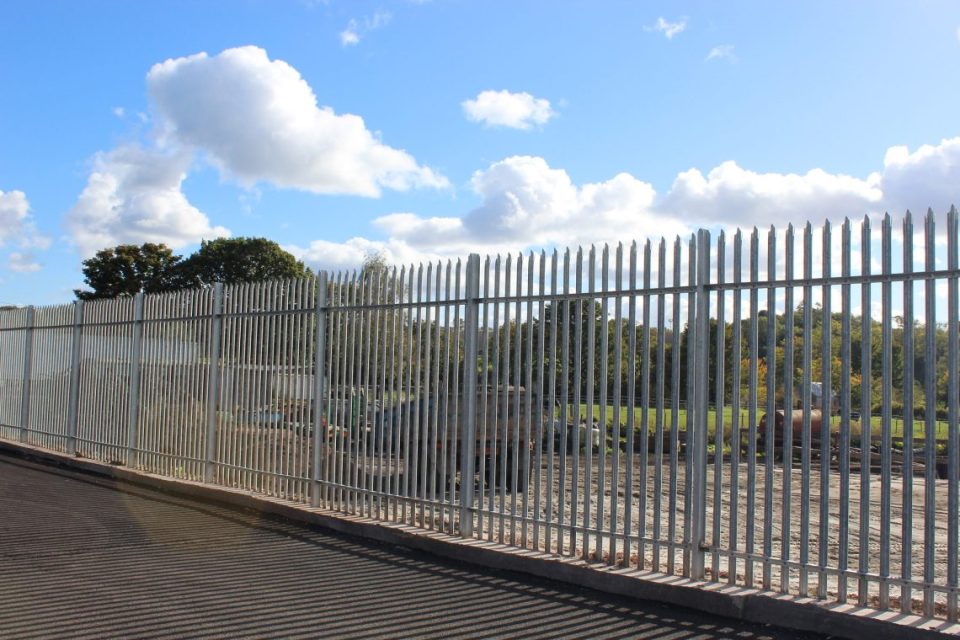
Steel palisade fencing is usually bought once and expected to last for decades, so first-time buyers get one chance to set the specification. Many compare prices before looking at profiles, coatings, fixings and gates, and that order causes problems later. For commercial fencing and site security, these details determine how the barrier performs over its life.
Start with the site’s risk profile
Suppliers sell two main pale profiles, and the difference between them is structural. D-section pales have a curved face and are used for general boundary marking on lower-risk sites. W-section pales carry three vertical ribs and resist bending and levering attacks.
For high-risk commercial and industrial perimeters, W-section is the standard specification. D-section still appears where the expected threat is casual trespass and the fence mainly defines a boundary line. Buyers should make the choice after an honest read of what the fence is expected to stop.
A basic risk review covers what the site holds, how visible it is from the road, how easily it can be reached and whether it has faced break-ins before.
Match the pale tops to the location
Pale heads come in several finishes, and the choice affects deterrence and public safety. Tri-point tops carry three sharp points on each pale and are recommended for industrial estates and storage yards. They are also the standard option where climbing is the main threat.
Round and notched tops present a safer profile. Specifiers place them near schools and pedestrian routes because an aggressive head creates an injury risk. Many projects mix the two, with tri-point pales on rear boundaries and rounded tops facing the street.
Local planning rules can restrict fence heights and designs near public roads, so buyers should confirm limits before ordering.
Check the coating and the standards behind it
Steel rusts when it meets air and water, so the coating decides how well the fence resists corrosion and how much upkeep it needs. Hot-dip galvanization to BS EN ISO 1461 coats every component in zinc, and the level of protection varies with the product and the site conditions. Buyers should ask suppliers for the coating specifications for each component, because those documents set out what a given fence is built to withstand.
Galvanization should cover cut ends and drilled holes, since exposed steel is where corrosion starts. Polyester powder coating adds a baked-on color layer over the galvanized steel, and buyers use it to match corporate branding. The two finishes work together, with each protecting the steel in a different way.
British Standard BS 1722-12 covers the manufacture and installation of steel palisade fencing, and it is the quality reference on any quote. Buyers can ask every supplier to confirm compliance with it in writing before comparing prices.
Source from a specialist who installs to standard
Palisade fencing is sold through national merchants and regional specialists, and the two routes differ for a first-time buyer. A regional firm typically surveys the site, then supplies and installs the fence, leaving one firm responsible for the whole job. Buyers comparing quotes should ask each supplier for written confirmation that every component meets the relevant British Standards, and Golden Larch Contracting’s palisade fencing can be weighed against other palisade options before requesting a written specification.
A site survey also catches problems early. Slopes, drains, buried services and soft ground all change the installation plan.
Specify the fixings and foundations
A palisade fence depends heavily on the parts a buyer rarely sees. Panels bolt to posts with high-tensile fixings, and installers specify shear nuts whose hexagonal heads snap off once tightened. What remains is a smooth surface with little for a wrench to grip, making unauthorized removal of the pales harder from outside.
Standard nuts and bolts can be removed with hand tools, which is why the fixing is part of the security. Posts sit in concrete foundations, and the depth and mix depend on soil conditions, fence height, wind exposure and gate loads.
Contractors set posts in Postcrete or a similar fast-setting mix and check alignment before the concrete cures. Skimping at this stage undermines everything built above it.
Plan gates and upkeep together
Gates need the same attention as the fence line because they are often the weak point. Suppliers offer pedestrian and vehicle gates built from the same palisade profile, at the same height, with locks matched to the site. Sliding gates suit yards with limited depth, while swing gates need clear space to open.
High-security sites can also pair the barrier with perimeter intrusion detection systems, which alert staff when the fence is disturbed.
Upkeep is modest once the fence is in the ground. Contractors advise a yearly walk of the perimeter to check gate hinges, locks, fixings and any chips in the coating. Small repairs keep the zinc layer doing its job and cost little compared with replacement sections.
None of these decisions requires specialist knowledge, but a few early questions help. A written specification covering profile, tops, coating, fixings and gates makes it possible to compare quotes on the same basis.
